Thursday, November 28, 2019

Happy Thanksgiving!


Today I am reminded of how much we have to be grateful for. So much is wrong with the world, yet so much remains right, and if not right, filled with hope for a better tomorrow.

Wishing you a wonderful Thanksgiving Day wherever you are in the world!

Monday, July 22, 2019

Writing In Your Character's Voice #amwriting

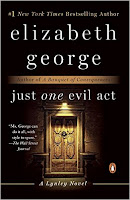
http://amzn.to/2d4opAP I'm reading JUST ONE EVIL ACT by Elizabeth George, a book in the Thomas Lynley series, and am struck by the way she uses different writing voices to represent her characters. George changes the tone, pace, 'sound', and feel of each scene depending on which character's point of view is represented. She does this by using that character's dialogue style and word choice, by deliberate selection of descriptive words in each scene, and by altering the structure of sentences.

It's fascinating. And effective. As a writer, I hope to emulate what she's doing. Maybe you will, too.


A bit of background: Elizabeth George's Lynley novels are set in current-day England and feature two main characters, Detective Inspector Thomas Lynley and Detective Sergeant Barbara Havers. Although he doesn't flaunt the fact, and indeed prefers to be judged based on his performance rather than his peerage, Lynley is the eighth Earl of Asherton. His speech, temperament, movements, and choices (from life choices to which socks to wear today) all reflect this.
Havers has had a difficult life and everything about her - speech, temperament, movements, and choices - reflects her background.
In short, Lynley is refined in everything he does and Havers is an unmade bed, physically and emotionally.

Elizabeth George writes Thomas Lynley's point of view chapters in a smooth, calm, and controlled fashion, reflecting Lynley's personality. When Barbara Havers is the point of view character, George's style becomes longer-winded, less formal, and harried. Haver's life is a mess and each of her scenes reinforces that fact.

These are subtle differences, written so well that a reader hardly notices a change from one scene to the next, but feels the change and the character's personality intimately. As a reader, George's techniques draw me in to each character's world.

Here are two examples of how George's style subtly develops each character. This scene occurs after Barbara Havers learns that a close friend has deceived her:

If this was true, it held up to doubt everything the Pakistani professor had said and done from that point forward. And if everything he had said and done from that point forward was one variation or another on a lie, then Barbara wasn't sure what she would do about that fact or to whom she would give that information.
The only answer seemed to be food. When she arrived home, she gobbled down a double takeaway portion of haddock and chips and followed this with treacle tart and a side of Victoria sponge. She quaffed a bottle of lager as she ate and finished off her meal with a cup of instant coffee. Accompanying this, she dipped into a packet of salt-and-vinegar crisps, after which a virtuous apple assured her that her arteries would be thoroughly cleansed if she munched upon it hard and long enough.
Then, no longer could she put off the phone call to Italy without putting herself into some sort of caloric stupor. She lit a fag and punched in Azhar's number. She'd never dreaded a phone call so much in her life. She was going to have to tell him everything: from the Love Rat Dad story to the claims made by the private investigator. In neither instance did she see that she had any choice.

I've got indigestion by association after reading about Barbara Havers' dinner and can physically feel her stress. The sentences run on and George uses words like 'gobbled', 'quaffed', and 'finished off' to show us Havers' distress. George could've told us that Havers was confused and angry, but instead she sends Havers on an eating binge, which is just how Havers would deal with discomfort at having to confront a friend she suspects of lying.

The next few paragraphs show Lynley at dinner with a woman he very much cares about, as she breaks off their relationship:

She smiled, it seemed, in spite of herself. "You know what I mean. You deserve someone who is willing and able to be one hundred percent for you, open to you, accepting of you...whatever you want to call it. I'm not that person, and I don't think I could be."
Her declaration felt like the thinnest of rapiers. It slid without effort under his skin, barely felt until the bleeding began. "So what are you saying, exactly?"
"I hardly know."
"Why?"
She looked at him. He tried to read whatever he could on her face, but time and circumstance had made her guarded, and he couldn't blame her for the walls she built. She said, "Because you're not an easy man to walk away from, Tommy. So I'm very much aware of the necessity of walking away and the marked reluctance I feel about doing so."

He nodded. For a moment they ate as the sounds of the dining room rose and fell around them. Plates were removed. Other plates came. He finally said, "Let's leave it at that, for now."

This passage causes no indigestion, but the turmoil beneath Lynley's reserved facade is clear. I have no idea what they ate, but I can feel the tension in their dinner through those six paragraphs. George could've told us that Lynley's heart was breaking, but instead she showed us.

It takes a skillful author to change styles between different point of view scenes and use each style to show so much about a character. Is this something you've noticed in your reading, or a skill you use in your writing? Is this type of showing a character's personality and development important to you?


photo credit: Seafood Medley via photopin (license)
photo credit: dinner party via photopin (license)

Monday, May 6, 2019

The Curious Incident of the Deer in the Nighttime - Memories and Writing

Do personal memories ever find their way into my writing? Oh yes. It's a hazard of the job, cataloging every noteworthy occurrence and trying to find a home for it in a novel. (If you're a friend or relative of a writer, rest assured, your personal life is constantly under scrutiny for future use.) In fairness, everyone defines 'noteworthy' in different ways. But take a gander at the following elements of an actual event, and tell me if you don't also find them noteworthy:

  • a hand-me-down 1977 burnt orange Chevy Vega;
  • two sixteen year old boys who share the privilege of squeezing behind the wheel of the Vega; and
  • one deer with a very bad sense of timing.


Maybe not so exciting when taken on their own, but when you combine them on a lonely country road after dark, things get a little more interesting.


The boys are my twin brothers, who at 6' 4" barely fit into that Vega (even with the driver's seat pushed all the way back, their knees still cradled the steering wheel). They were coming home from basketball practice one evening, minding their own business, when a deer dashed out of the brush and smacked into the side of the car. The poor thing hit the car hard enough to knock itself out and leave a dent in a fender. My brothers, good Samaritans and smart enough to know that there was no way our mom would believe that they weren't responsible for denting the car, hoisted the unconscious deer into the Vega's hatch area, and then one of my 6' 4" brothers folded himself in half, climbed into the tiny hatch area with the deer, and held its feet just in case it woke up on the drive home.

Alas, Mom did not believe them despite the presence of an unconscious deer in her car and reassurance from her husband and her Sheriff's deputy brother that yes indeed, deer do occasionally get the timing wrong and run into a car instead of in front of it. My brothers suffered mightily for the damage that deer did to the poor little Vega.

Until, that is, the same thing happened to my mom in her big ol' honkin' brown Oldsmobile.

Same road. Same time of day. Same spot on the fender. Different deer, one hopes.

Mom did not bring the deer home as proof of how the big Olds got dented, but she forgave my brothers. Grudgingly.


Did I use all this in a story? Heck yes. In THE DEVIL OF LIGHT, after my fictitious Grove twins hit the deer, they got distracted by a glow off in the forest and go to investigate. That leads them to a fire pit where a human foot has just been burned. Toward the end of the book, their mother gets hit by a deer (on a different road), and ends up being held captive by a cult.


I'm not sure it's possible to keep our memories and our writing separate. And I think that's a good thing. A touch of reality adds flavor and more often than not a little hilarity. Who couldn't do with more of that?


photo credit: A. Drauglis White Tail Fawn via photopin (license)
photo credit: liverpoolhls Bones of the foot via photopin (license)

Saturday, December 1, 2018

#Reader #Conversations Are Awesome #Inspiration - #amwriting

Writers find inspiration everywhere, and often, readers inspire us the most. I’ve had the pleasure of attending several book signings and writer talks, and have even hosted a book launch party at a local winery. Every event and every reader I've met has been a blast.


Most readers ask similar questions – where story ideas come from, whether my character Cass Elliot is named after the famous singer, or how long it takes to write a book. Some share story ideas – like the time a urologist was literally pulled out of bed to perform kidney surgery on a mafia boss while gowned armed guards stood watch in the operating room. How's that for inducing performance anxiety?


Occasionally someone comes to an event with a gleam in their eye and a detailed list of questions:

How could you end THE DEVIL OF LIGHT without bringing the old man to justice? I want him dead. Or at least in prison. (All I can say is, I’m writing a series. I know, I know. THE DEVIL OF LIGHT leaves the reader hanging, and maybe I could’ve ended that book better. All I know for sure is that the old man isn’t done with Forney County, and Cass isn’t done with him.)

Please don’t let anything bad happen to Hitch. I know he’s a horrible multiple murderer, but I kind of like him. (I kind of like him, too. Which worries me a bit. I’d like for him to hang around Forney County for a while, but we’ll see where the stories go.)

I really loved your writing style in A CASE OF SOUR GRAPES, but I don’t like Maxine. She’s too into her handbags and shoes. Couldn’t you write like that but use Cass as your main character? (I hear you, but it wouldn’t work. Maxine and her foibles are as key to the plot as is the search for the missing husband – Cass is too intense to bring that level of impulsiveness and misadventure to a story.)

But my favorite reader interaction to date occurred at church, which is a little weird given that I write crime novels with a certain level of violence. A lady with the sweetest disposition pulled me aside one Sunday and said, “I thought about you yesterday.”

“Really?” I asked.


“Yes. My son killed two deer and was processing them, getting ready to put them in the freezer. While I watched, I realized how hard it must be to actually dismember a human body.” Slight frown. “Or at least to do a neat job. It’s not easy to take a leg off at the hip without making a mess. It’s got to be even harder to saw through bone like Hitch did. What do you think?”


We spent the next several minutes, this gentle lady and I, discussing how one would go about cutting up a human body. Where would you do it? What about evidence? What do you do with all the parts? Dig a hole? Use a wood chipper? Where does one find a wood chipper in a rush? How much bleach would it take to clean up?

The fact that we were in the church foyer with congregants streaming around us didn’t bother either of us in the least.

“Well,” she said, patting my arm. “Just wanted you to know I was thinking about you.” And off she went to refill the coffee urn, leaving me to wonder if she would ever have thought about dismembering a human body before reading my books.

I certainly hope so.

I can’t afford that kind of therapy for my readers.

Where is the most unusual place you've had a discussion with a reader or writer?


photo credit: Alistair-Hamilton Bookshop 4 via photopin (license)
photo credit: PHOTOPHANATIC1 deer via photopin (license)

Monday, October 1, 2018

A New Kelsey Porter #Thriller from @elysesalpeter - THE SEARCH FOR STARLIGHT #artknb #amreading


I am excited to share my friend and bestselling author Elyse Salpeter's newest novel with you - THE SEARCH FOR STARLIGHT, available October 1, 2018!

This is the fifth installment in the Kelsey Porter thriller series, culminating the journey of the young woman who has come full circle in her quest to find her parent's murderers. THE SEARCH FOR STARLIGHT is also the final installment in the series, and Elyse promises that it answers all our questions from the series and offers a few surprises along the way.


About THE SEARCH FOR STARLIGHT:
She just needed to complete a simple errand... how hard could that be?

As soon as Kelsey embarks on the Emperor and Empress's request to locate a mysterious object and return it to them, her entire world is plunged into chaos.

Someone is following her, someone else has broken into her home, and now she believes the people she trusted most have all been lying to her.

As Kelsey unravels the truth, she learns that her journey to this moment has never been entirely her own. Until now.
https://amzn.to/2R4mr6Y

 
Because THE SEARCH FOR STARLIGHT answers so many questions and includes a few surprises (right from the start!), I don't want to include any spoilers by sharing an excerpt. Instead, to whet your appetite for the Kelsey Porter series, here's an excerpt from the first book, THE HUNT FOR XANADU (on sale for only 99cents through October 31, 2018):


Present Day

Hidden in the security camera’s blind spot, she sucked in her gut, closed her eyes and listened intently. “Come on, already,” she thought, drumming her fingertips rapidly against the brick wall. She heard the dogs panting now. This sound had replaced the earlier frenzy of them tearing into the drugged, raw hamburger she had thrown over the fence just twenty minutes before. She’d crushed thirty-six Acepromozin tablets into the ground meat, reckoning it would be enough to knock out the four guard dogs, if not kill them outright.

She glanced at her watch and waited. This is taking so long. Five more minutes passed, with nothing sounding except the soft, rotating click of the camera. Abruptly, she yanked down the protective goggles resting on her head and placed them over her eyes. The clicking now echoed loudly, indicating the camera was once more faced in her direction.  Brazenly she stood, aimed her laser gun and pointed it directly into the lens. The high tech, silicon-based CCD camera had an impressive wavelength sensitivity. The laser's high-powered emitter instantly saturated the pixels of the camera's CCD sensor and burned the chip out instantly.

Ricardo Perez thought he protected himself with the best of everything. He’d under-estimated meeting an assassin so invested in seeing him dead.


Still undecided about starting a series by a new author? Check this out. If you, like me, are a fan of the Agent Pendergast series, this review of THE HUNT FOR XANADU should give you comfort that you're in for a great read:

The Hunt for Xanadu by Elyse Salpeter is a remarkable novel, a fascinating and fantastical journey in time and space, and one of the most gripping novels I've read in a long time. It flies along at the pace of a thriller, with plenty of murder and mayhem along the way. But behind the thrill-ride is a spiritual story, an archetypal tale of mystery and darkness, riddled with fascinating and esoteric concepts in Tibetan Buddhism. Vivid characters, a truly appealing protagonist, unexpected twists, and crisp writing complete this unforgettable book. I can't wait to read the next one in the series!
Douglas Preston, #1 bestselling author and co-creator, with Lincoln Child, of the Pendergast series

Grab a copy of THE HUNT FOR XANADU for 99cents through October 31, 2018 and dive into your next favorite thriller series!


Meet Elyse

Elyse Salpeter is an author who loves mixing "the real with the fantastic" in her books. She likes nothing better than taking different scenarios and creating worlds where things just aren't what they appear to be.

Her 5 book thriller series, THE HUNT FOR XANADU, THE QUEST OF THE EMPTY TOMB, THE CALL OF MOUNT SUMERU, THE HAUNTING OF CRAGG HILL HOUSE, and THE SEARCH FOR STARLIGHT are about a brilliant and fearless young woman named Kelsey Porter, whose life is steeped in Buddhist spiritual mysteries. She is constantly discovering the world around her is not what she believed it to be.

Her Dark Fantasy Series, THE WORLD OF KAROV and THE RUBY AMULET take us to other realms filled with magic and evil as a dark presence is seeping through the dimensions.

Her YA novels, FLYING TO THE LIGHT and FLYING TO THE FIRE are about a young deaf boy who knows what happens to you when you die and now people are after him for the answers.

Lastly, her horror novel, THE MANNEQUINS, is about a film crew that enters an abandoned mansion and disappears, while her horror anthology, RICKET ROW is filled with creepy tales, guaranteed to keep you up at night.

When she's not writing, she's cooking, gardening, running around with her twins and eating shock food in her Gastronaut Club.


Connect with Elyse

Check out her website: www.elysesalpeter.com
Find her on Twitter @elysesalpeter : https://twitter.com/elysesalpeter
Find her on Facebook: www.facebook.com/elysesalpeterauthor

And of course, you can find all of Elyse's hard copy and ebooks on Amazon!